Powered Wheelbarrow vs Manual Barrow: The Real Cost per Tonne Moved
2026-10-12 · 2 min de leitura
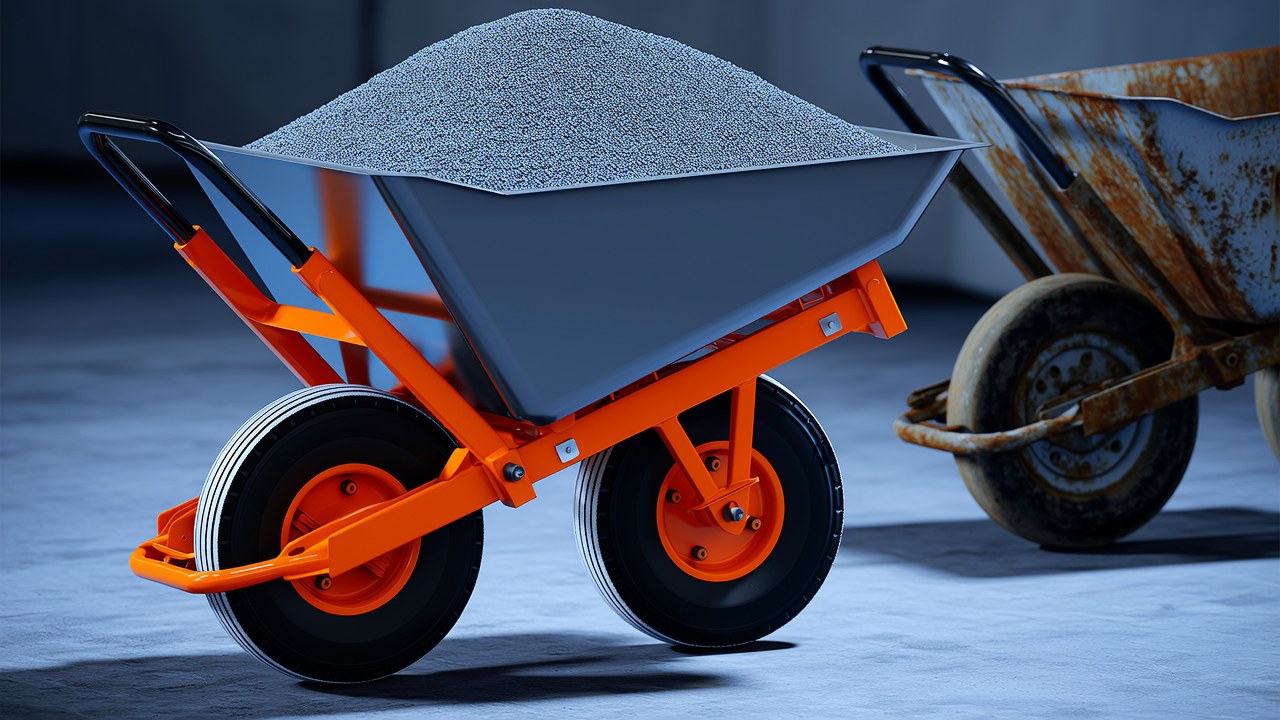
The argument for a powered wheelbarrow is not that it is faster. It is that it removes the constraint of human stamina from the job. A manual barrow carries perhaps 80 kg per trip at walking pace on firm ground, and considerably less on soft ground or a slope. A powered unit carries 500–800 kg in the same trip.

The arithmetic on a pour
Take a 20 m³ concrete pour. At roughly 2.4 t/m³ that is about 48 tonnes to move. With a manual barrow at 80 kg per trip that is 600 trips. On a 30-metre run at walking pace with loading and tipping, each trip is realistically 60–90 seconds, so 10–15 operator-hours. That is two labourers for an entire day, and by the afternoon the rate has dropped.
At 600 kg per trip the same job is 80 trips. Call it 1.5–2 hours for one operator who is not exhausted at the end of it. The saving is not 20% — it is most of a working day, on every pour.
Where the saving is largest
- Slopes and ramps, where a manual barrow becomes dangerous as well as slow
- Soft ground, where a barrow sinks and the load must be reduced
- Distances over about 20 metres, where trip count dominates
- Confined sites where you cannot bring in a vehicle or a forklift
- Any job where the same crew is also doing skilled work
Where a powered barrow does not help
Very short runs — under about 10 metres — where the machine's own weight and turning time are a real cost. Stairs, obviously. And sites so tight that the machine cannot be turned, although the 360° steering on most modern units covers more than you would expect.
Energy cost is almost irrelevant
A 48 V 20 Ah pack holds roughly 1 kWh. Depending on local electricity prices that is a few cents to a few tens of cents per charge, and one charge covers a substantial part of a working day. Compared with a diesel equivalent the energy saving is significant, but it is not the reason to buy one. The reason is operator-hours.
What to actually compare
Do not compare purchase price with purchase price. Compare the number of operator-hours the machine removes per year against its purchase price and its maintenance. Bearings, tyres, batteries and the occasional controller are the wear items. An engine overhaul is not, because there is no engine.
A realistic word of caution
These machines are not indestructible. Cheap units arrive with under-specified controllers, thin hoppers and batteries that fail inside two years. Buy a machine with a stated steel thickness, a brushless motor and spare parts you can actually order — otherwise the labour saving is eaten by downtime.